Using AI for Keyword Ideas, and Why It Cannot Tell You Demand
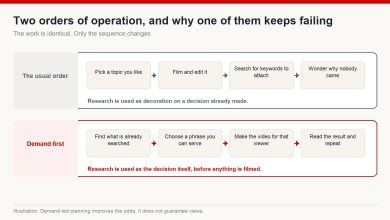
The most expensive mistake in this whole business is making the video first and looking for the audience afterwards. It costs a week, and the answer you get at the end — nobody was looking for this — was available in twenty minutes at the start.
Language models have made the front end of that twenty minutes much faster. What they have not done, despite a lot of confident claims, is tell you whether anybody is searching for anything. That distinction is the whole subject of this article, because getting it wrong produces research that looks thorough and is entirely fictional.
Three jobs, three different things doing them
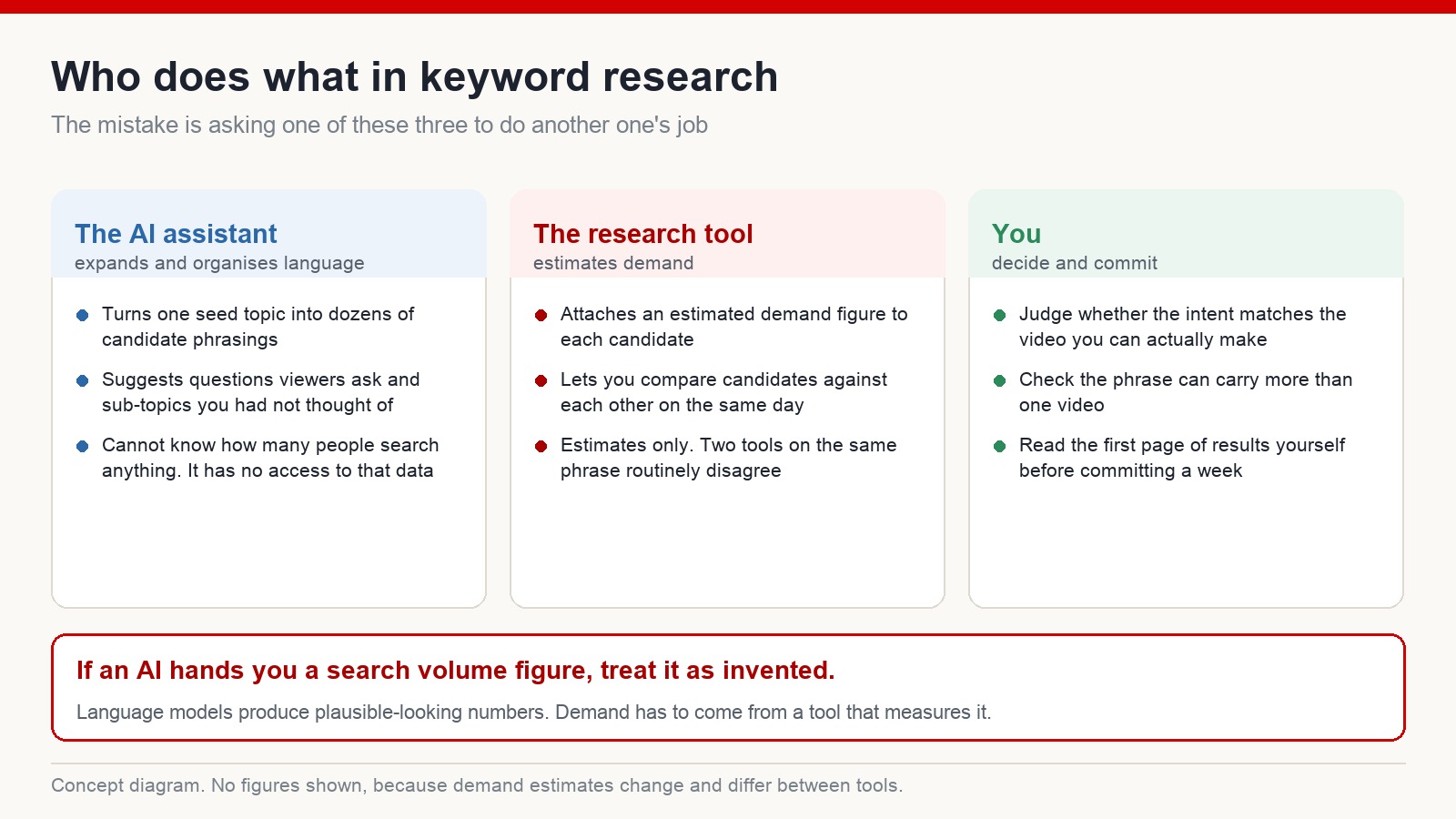
The AI assistant expands language. It turns one broad topic into dozens of phrasings, sub-topics and the questions people ask around a subject. It is genuinely good at this, and much faster than staring at a blank page.
The research tool estimates demand. It attaches a rough figure to each candidate so you can compare them against each other. Estimates, not counts — two tools looking at the same phrase on the same day routinely disagree, and both revise over time.
You decide. Whether the intent matches a video you can actually make, whether the phrase can carry more than one upload, and what the first page of results already looks like.
The failure mode is asking one of the three to do another one’s job. Overwhelmingly the common version: asking a language model for search volume. It will give you a number. The number is invented. Models produce plausible text, and a plausible-looking figure is exactly the kind of text they are best at. If a demand figure did not come from a tool that measures demand, treat it as fiction.
Step one: expand a seed topic
Start with something too broad to be a video. Say venomous snakes. Nobody types that expecting a specific film, and no single video can serve everyone who does.
The prompt below is the one I actually use. It is deliberately plain, and the constraints in it are what stop the output being useless.
You are helping me plan a YouTube channel for English-speaking viewers about [TOPIC].
Give me 30 candidate search phrases that a viewer might type into YouTube to find a video on this subject. Rules:
1. Write them the way a normal viewer would type them, in lower case, not the way an industry expert would write them.
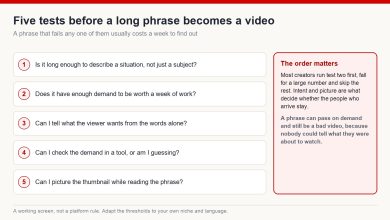
2. Each phrase must be four words or longer and describe a specific situation, comparison or question — not just a topic.
3. Cover a mix: beginner questions, comparisons between two things, identification and how-to, and things people are afraid of or curious about.
4. Do not invent search volumes, competition scores or any other numbers. I will check demand separately.
5. Group them under short headings so I can see which sub-topics have the most candidates.
Rule four matters more than the rest combined. Without it you will get a tidy table with a volume column, and every figure in it will be made up.
Two follow-ups worth running afterwards: “For each group, what does the viewer most likely already believe that is wrong?” and “Which of these phrases would a small channel realistically be able to answer better than a large one?” The first produces angles. The second produces a shortlist.
Step two: verify every candidate
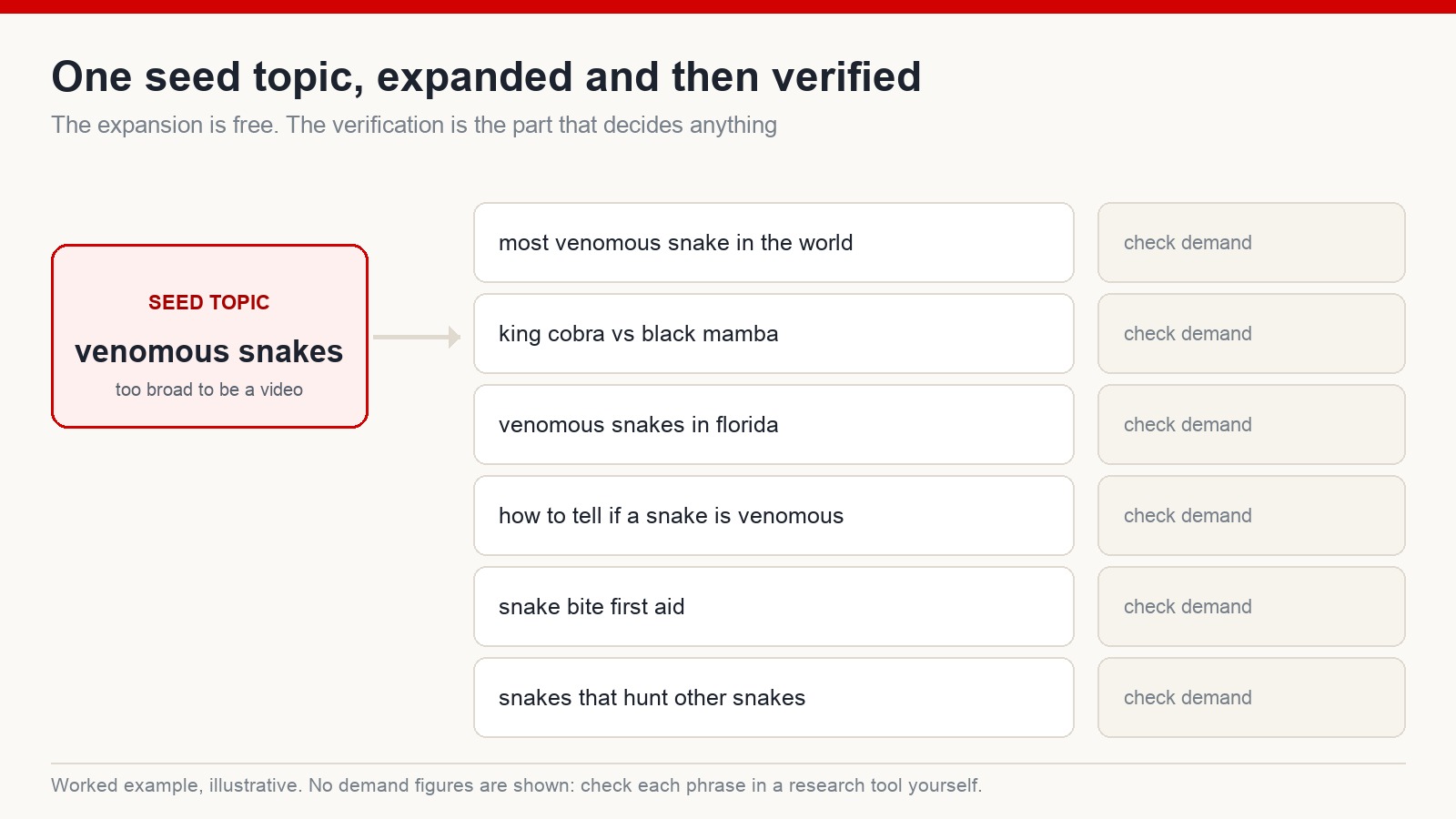
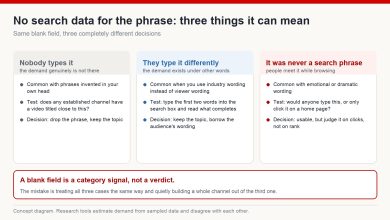
Take the list into a research extension — the mainstream ones all do this job adequately — and check each phrase one at a time. What you are looking for is not a single big number. It is the shape of the list: which candidates have obviously more demand than the others, which come back with almost nothing, and which return no data at all.
From the snakes example, a shortlist might come out as most venomous snake in the world, king cobra vs black mamba, venomous snakes in florida, how to tell if a snake is venomous, snake bite first aid, snakes that hunt other snakes. Six candidates in the same territory that will not perform the same way at all — and the only way to know which is which is to check them.
Three habits that make the check worth doing:
- Check in the market you publish to. A phrase can look substantial worldwide and be thin in the country your audience is actually in.
- Check the same phrase in a second tool when a decision hinges on it. A disagreement between two tools is a reason to be careful, not a reason to pick the higher figure.
- Write down the date. Demand drifts and estimates get revised, so a figure from three months ago is a historical record rather than a current reading.
Step three: read the results page yourself
This is the step people skip because it is not automated, and it tells you more than the numbers do.
Search the phrase on the platform and look at the first screen. Are the videos answering the question directly, or circling it? How old are they? Are they from channels with years of back catalogue, or from small channels that happened to be clear? Is there an obvious gap — nobody covering the thing the comments keep asking about?
Ten minutes of this will overrule a competition score most of the time, because you are reading the actual supply rather than an estimate of it.
Why smaller phrases keep winning for small channels
The instinct is to chase the biggest demand you can find. It usually goes badly, for a reason that has nothing to do with the algorithm being unfair.
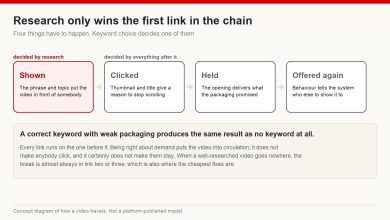
A broad phrase brings people with a dozen different intentions. Most of them wanted a different video, and their leaving is the loudest signal your upload produces. A narrow phrase brings fewer people who mostly wanted exactly this, and they stay — which is the behaviour that decides whether anyone else gets shown the video.
So the advantage of a narrow phrase is not that it is easier to rank for. It is that it stops you being shown to people who were never going to stay. That said, competition is not determined by demand alone: a small phrase in a subject full of well-funded channels can be harder than a larger phrase nobody has bothered to answer properly.
Using the phrase once you have it
Put it in the title, in natural word order, inside a sentence a person would say. Use it, and its close variants, in the description where they belong — not as a list bolted on at the end. Say it out loud in the video, because it is usually the clearest way to state what the video is about anyway. Group related videos into a playlist so a viewer who liked one has an obvious next one.
One myth worth retiring: writing keywords in lower case does not improve anything. It is a tidiness preference and nothing more. Nor does repeating the phrase four times in a description; that reads as spam to the only audience that can actually reward you.
The whole routine
- Pick a subject broad enough to sustain a channel and too broad to be one video.
- Use an AI assistant to expand it into candidate phrasings, with numbers explicitly forbidden.
- Check every candidate’s demand in a research tool, in the right market.
- Read the first page of results for the survivors and see what already exists.
- Choose phrases that fit both the audience and the videos you can realistically make.
- Publish a batch, then read your own analytics by group rather than one video at a time.
Step six is the one that turns this from a research exercise into a system. Your own numbers are the only data source in this list that is actually about your channel.
What it cannot do
None of this guarantees views. It removes the failure you cannot recover from — a week spent on a video nobody was looking for — and leaves every other failure intact. Packaging, the opening, consistency and timing all still decide what happens.
Estimates change, platform behaviour changes, and results differ enormously between channels and subjects. Treat the process as a way to make better bets, not as a forecast.
Frequently asked questions
Can an AI tell me a keyword’s search volume?
No. It can produce a number that looks like one. Demand has to come from a tool that measures it, and even then it is an estimate.
Is there a search volume range I should target?
No universal one. Published recommendations differ widely because they come from different niches, languages and channel sizes. Find your own workable range by checking a batch of phrases and then reading what your videos actually do.
Should demand be the only thing I look at?
No. Intent, existing supply, seasonality and whether the phrase can carry a run of videos all matter, and the last one matters more than most people expect.
How many phrases should I check per video?
Enough to have something to compare against — a couple of dozen candidates for a batch of videos is a reasonable working number. A single phrase checked alone tells you nothing, because there is no context for the figure.
Does writing keywords in lower case help?
No. There is no evidence for it. Consistency helps you keep your own records tidy, which is a different benefit.
If you want the whole workflow for building a faceless channel aimed at English-speaking audiences, that is what I teach at mmoyoutube.com. Results vary by channel, subject and market.